
 Hrvatski
A3 Regular Annual Meeting will be held on Friday, November 8th, 2019, at 5 PM, in the Great hall in 3rd Wing at the Institute Ruđer Bošković, Bijenička c. 54, Zagreb, Croatia.


Adriatic Aerospace Association
Association of research institutions and high technology firms.
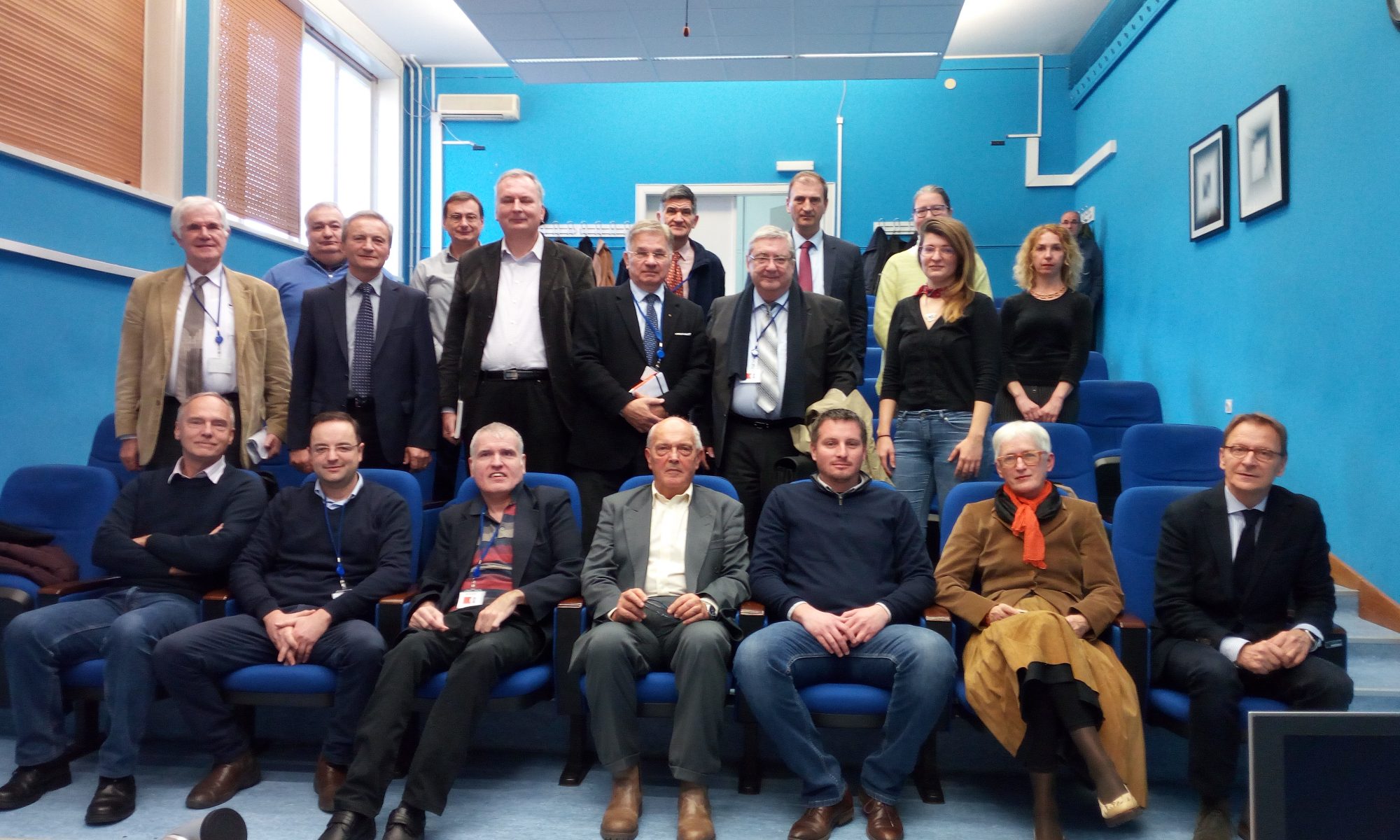

This document is the result of the panel discussion on the topic “Small Countries in Space Era”, motivated by the rapidly evolving development in Space exploration, utilization of the benefits from it for the well being of humanity, and future presence of humans out there. Small countries should also find their role in this endeavor but in competition with large conglomerates the question is HOW?
Preamble
A stable and prosperous society needs to be inventive in science and technology, and to be globally competitive. Two factors that determine success are highlyeducated members of the community and leadership in new ideas. For a small country, with a reasonably educated population, it is therefore of utmost importance to recognize global trends in the field of science and technology and to focus their development efforts in this direction. Research and development in Space activities offer opportunities to small countries to participate as an active member. This primarily requires defining development strategies in the field of aerospace high technology industries, basic science and development, as well as activities in the field of space medicine, space law and space tourism.
Recommendations
The essential feature of Space programs is that it is interdisciplinary and that it falls under the responsibilities of several ministries. Therefore, the first step towards commencing a Space program is setting up a Space Agency funded by the ministries of Science, Transport, Economy (where technology is incorporated) and Defense. The National Space Agency should ideally cover all sectors of Space program, with experts in respective fields. The next step after establishing the Space Agency is to draft and adopt the National Space Strategy that would entail two principal segments
Both of these segments form the basis for accession to the membership of the European Space Agency. The Space Strategy should encompass the long term and short-term development objectives and define the areas of priority.
The path to become a full member of ESA is to first sign the Framework Programme and then to become a co-operating state and thereby join the PECS (Plan for European Cooperating States) programme. The PECS Charter, which lasts for five years, enables the country to develop its space industry with ESA’s support. The next step is then the Associate Membership of ESA and lastly, the Full Membership of ESA. The National Space Agency would represent the country in the ESA council and programme boards. It would also advise the government on levels of commitment in the optional programmes of ESA in line with the space strategy. To support the creation of space start-up companies it is advisable to set up an ESA Business Incubation Centre (ESA-BIC).
In parallel, there should be a national space programme to prepare industry and academia for the competitive environment of ESA and EC contracts and to enable fruitful bi-lateral collaborations.
As a member of the European Union, the country also should participate in the down-stream space programme of the EU, which is implemented by the European Commission. Examples are Satellite Navigation (EGNOS and Galileo), Earth Observation (Copernicus), Space Situational Awareness (SSA) and the GOVSATCOM Programme. To utilize the Public Regulated Service of Galileo Ministries of Interior and Defence should set up a Competent PRS Authority (CPA).
Prof. Dr. Slobodan Danko Bosanac
President
Adriatic Aerospace Association
The signatories to the document are:
Petr Bares, President, Czech Space Alliance
Prof. Dr. Sc. Slobodan Danko Bosanac, President, Adriatic Aerospace Association
Mag. Dr. Andreas Geisler, Appointed Head of the FFG Aeronautics and Space Agency.
Prof. Dr. Tomaž Rodič, Director, Slovenian Centre for Space Sciences and Technologies
Prof. Dr. Carsten Scharlemann, Head of Deparment, Aerospace Engineering, University of Applied Sciences Wiener Neustadt
Prof. Heinz Stoewer, Founder of Space Associates GmbH
Dr. Sc. Hrvoje Zorc, Adriatic Aerospace Association
Mag.iur. Anja Nakarada Pečujlić, Serbian Case for Space

This article is only available in Croatian.

Adria Space Conference 2019
Regional Cooperation on SpaceTechnology
Organizer:
Adriatic Aerospace Association (A3)
Ruđer Bošković Institute
University of Zadar
Sponsored by:
The Ministry of Economy, Entrepreneurship and Crafts of the Republic of Croatia
Chair: Slobodan Bosanac Ph.D., President of the A3
Adriatic Aerospace Conference is the organizer of the first regional meeting devoted to collaboration in space technologies. The goal of the Conference is to stimulate and strengthen the regional cooperation in research and development of advanced technologies, mainly used in space activities. The profile of the Conference is one-day meeting, where all participants will briefly report on their current activities and future programs. This should give push for further common developments in the field of nano-satellite technologies like construction, functions, propulsion, communication, attitude control, and similar. It is intended that the conference acquires annual character as a gathering of participants in space research and development in SE Europe.
More information on web page of the Conference.
Organizing Committee:
S. Bosanac, Ph.D., Adriatic Aerospace Association
M.Ivanda, Ph.D., Ruđer Bošković Institute
I. Jakić, CEO, IJEX GmbH
D. Kočiš, Adriatic Aerospace Association, World Space Week Croatia
I. Ljubić, Ph.D., Ruđer Bošković Institute
G. Verbanec, Ph.D., University of Zagreb, Faculty of Science,
H. Zorc, Ph.D., Adriatic Aerospace Association
S. Petrović,
D. Ramljak, Ph.D., Senior Science and Innovation Expert The World Bank

At the beginning of July 2019, a Cooperation Agreement was signed between the Adriatic Aerospace Association and the Northwestern Polytechnical University (NPU) School of Astronautics. The NPU is the most prestigious in astronautics in China with a wide spectrum of activities, which will be a great incentive for the development of the space program in the Republic of Croatia. On the side of the NPU, the Signatory of the Contract is Prof. Dr. Yi Li, Deputy Dean of the School of Astronautics, while on the A3 side the signatories where Prof. Dr. Sc. Slobodan Danko Bosanac, President A3, and Prof. Dr.-Ing. Ognjan Božić.

This article is available only in Croatian.
 Hybrid rocket engines have the future and they are in the phase of intense research and development. Hon. Prof. Dr.-Ing. Ognjan Božić, an A3 member, led until this year the DLR team that develops that aspect of rocket propulsion. The report on the work on the project has been published on the DLR website.
„In the spring of 2019, the innovative hybrid rocket engine “AHRES-B” was successfully tested on the test bench “block of four” at the German Aerospace Center (DLR) in Trauen. For the researchers a special reason to enjoy, because hybrid rocket engines are not only fundamentally cheaper and safer than conventional rocket engines, AHRES-B is also significantly more effective than all its predecessors. The current test has shown that the technological development of hybrid rocket engines is now well advanced enough to be used, for example, on sounding rockets.
The advantage: hybrid rocket engines are combinations of solid and liquid engines and combine the best features of both engine types. The liquid oxygen carrier – in this case highly concentrated hydrogen peroxide – and the solid fuel HTPB (hydroxyl-terminated polybutadiene) are initially separated in AHRES-B and only meet in the combustion chamber. As a result, there is no risk of explosion during storage and operation. In addition, the substances used are non-toxic and not harmful to the environment.“
This article is available only in Croatian.
Flying and reaching stars is one of the greatest incentives for imagination and creativity, and the “Space” is the key word that unites it. Encouraging creativity in the direction of space activities resulted in many successes in the exploration of Space as well as in the development of the material side of civilization. Initiative of A3 to establish Sections for Space Technology in Secondary Schools had precisely this ambition, to get students to know how some of their imaginations can be achieved. However, this initiative has also resulted in a completely different purpose, re-socializing children with problematic behavior. This direction of activity was noticed by Damir Preksavec, a teacher at the Mali Lošinj Resocialization Center (House), which has an internal vocational school under the auspices of Center of Education and has been operating since the foundation of the House in 1952, by establishing the Space Technology Section. Students, attendees of this school are children coming from all over Croatia.
According to Damir Preksavc, the Section for Space Technology helps his students in the process of re-socialization by teaching them competence in the field of mechanical engineering, electrical engineering, information technology and other topics.

The Section is regularly attended by ten students and we are aware that our students are not interested in scientific work. Therefore, we emphasized the practical work and so, for example, the student Philip Filipović made from the wooden materials the model of the F-16. The plane is under construction. Great creativity of the student was used when making the plane, which is definitely important for the development of space technologies.
About school
The school is an indispensable part of the program of re-socialization of children and adolescents with behavioral disorders, and provides opportunities for education of children from the local community, especially in programs that are not represented in high school “A. Haračića “in Mali Lošinj.
The school carries out a curriculum for secondary education for the following three years of occupation:
1. Field of mechanical engineering: turner, plumber, locksmith and tinsmith
2. Field of catering and tourism: chef and waiter
3. Woodworking: woodworking
and two-year occupations:
1. The field of mechanical engineering: machine and construction monter
2. Field of work catering and tourism: assistant chef and assistant waiter
3. Wood Processing Area: Flooring
We also conduct an adult education program for all of these professional occupations. A training program is also being carried out for the pursuit of a profession in the profession of welder. We also have a primary school that we are pursuing according to the adult education program.
In addition to the school itself, we also have workshops where students take the knowledge of the professions for which they are trained (lathes, locksmiths, welders and carpenters), students attending waiters and chefs participate daily in preparing and serving lunches for all users of the House.

This article is available only in Croatian.